
'Pakistan is no longer a front-burner issue for America.'

The influential Indian-American community has swung back to action to push the N-deal ahead.
A frustrated and angry America Inc believes it has been let down by Delhi after all of its lobbying to push through the deal in the US Congress, reports Aziz Haniffa in Washington, DC.

'Trump's sons, and the son of Trump's Mideast envoy Steven Witkoff, are in the crypto business and recently signed deals with Pakistan's crypto council.' 'It may not be coincidental that not long before the Trump-Munir meeting, the head of Pakistan's crypto council met with Trump's White House crypto policy czar.'
The ranking Republican on the powerful Senate Foreign Relations Committee, Senator Richard Lugar, has bemoaned the fact that more than three years after the historic US-India civilian nuclear deal was signed, it still remains in limbo sans any implementation.
With billions of dollars in military technology agreements likely to be made with the United States-India nuclear deal going through, there's an excited buzz among American companies.

'Unfortunately, India and Pakistan could learn a 'lesson' from this conflict that will make them more likely to use these weapons against each other in the future.' 'Rounds of missile and drone attacks could be more routine features of their hostility, just like artillery fire has become a familiar fact of life along the Line of Control.'
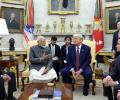
'By his words, actions, and body language during their joint press appearance wanted to convey his personal respect and, more broadly, his desire to work closely with India.'
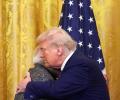
'He needs to see results while he is in office.'
"The N-deal is not only the highest visible symbol of cooperation between India and the United States, it represents a new turn -- it is a very special cooperation."
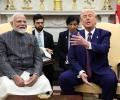
'Trump administration wanted a positive tone at this summit, but there was still some anxiety that there could be some awkward moments -- and there were not.'

'Now it's for India to also make certain decisions. The sky's the limit. You've got to be strategic.'
The administration is leaving no stone unturned as it races against time to have the US-India civilian nuclear agreement completed by the Congressional adjournment date of September 26 even if indications are there that the lawmakers may return for a Lame-Duck Session after the November 4 presidential elections.
George Perkovich, vice president, studies, and director, Nuclear Policy Program, Carnegie Endowment for International Peace, believes that with the United States-India nuclear deal in limbo, the lack of convergence between Washington and New Delhi on Iran, climate change, the World Trade Organisation, and stagnation of defence cooperation, the US-India relationship has indeed been oversold.
Maintaining that both India and the US are seriously trying to sort out the 'outstanding issues', he, however, refused to specify when the agreement will be firmed up.
The delay in the Nuclear Liability Bill, which has faced vehement protests by the Opposition in Parliament, has become a worrying factor for United States business and industry circles.
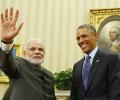
With their landmark 2005 civil nuclear deal still in limbo, India and the United States have established an inter-agency contact group to sort out outstanding liability and technical issues to fast-track its full implementation.

The landmark civil nuclear deal sealed on Friday with Japan is strikingly similar to the agreements India has with the US and some other countries but contains some added features on safety and security, reflecting Japan's concerns on the issue.

'And if the United States, at that time, perceives India to have welched on the deal, not been our friend, when we did so much to make it a friend, that's trouble.'

'That they don't have a say in the UN, like China, is hard for me to understand,' says US Congressman Joseph Crowley.
It may not be the easiest of deals to forge, but with patience and understanding it can be done
Nicholas Burns, the lead negotiator on the US-India nuclear deal in the Bush administration, has said that Washington must reassure New Delhi that it is a "valued strategic partner."
With the Indo-US civilian nuclear deal in a limbo in the wake of the Indian Parliament's nuclear liability law, the Barack Obama administration has asserted that complete implementation of the accord is imperative for the full transformation of the relationship.
Maintaining that he is not aware as to when exactly the US-India civilian nuclear agreement is going to be formally inked, the State Department's deputy spokesman Robert Wood said the important thing is that the deal has been finalised and what remains now are just administrative matters.
With India virtually putting on hold its civilian nuclear agreement with the United States, Australia has decided to review its plans to sell uranium to New Delhi. Efforts for a US-India nuclear pact, which would open India to IAEA, paved the way for Australia's uranium deal with India. Following reports that the negotiations for the operationalisation of the Indo-US deal have been stalled, Foreign Minister Alexander Downer said Australia will need to consult New Delhi.
N-deal: Hurdles before Congressional approval
Swadesh Chatterjee, coordinator of the US-India Friendship Council--the umbrella organization of community groups--that was formed exclusively to lobby on behalf of the deal in Congress, said, "Disappointment is an understatement."
The Obama Administration has reiterated its strong commitment to the US-India civilian nuclear deal consummated during the tenure of the previous George W Bush Administration and said it's "embedded" in a broader strategic dialogue between Washington and New Delhi, but contended it's certainly not a template for negotiations with the likes of Iran.
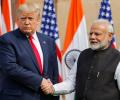
The China threat continues to resonate in the strategic partnership between India and the USA, points out Rup Narayan Das.

US President George W Bush on Thursday signed into law the legislation to implement the historic Indo-US civil nuclear deal paving the way for the two countries to formally ink the 123 agreement on Friday.
The Bush administration has been firm in its support for the US-India civilian nuclear agreement and it continues to be so, a US State Department official said. Gonzalo R Gallegos, director, Department's Office of Press Relations, made this observation when asked about more information on the reports that the nuclear deal between the two countries is close to dead.
'If we could break through this symbolic barrier of sanctions and a dysfunctional relationship, we could do anything.'
 © 2026 Rediff.com - Advertise with us - Disclaimer - Privacy Policy - Sitemap - Feedback - About us - Terms of use - Grievances